
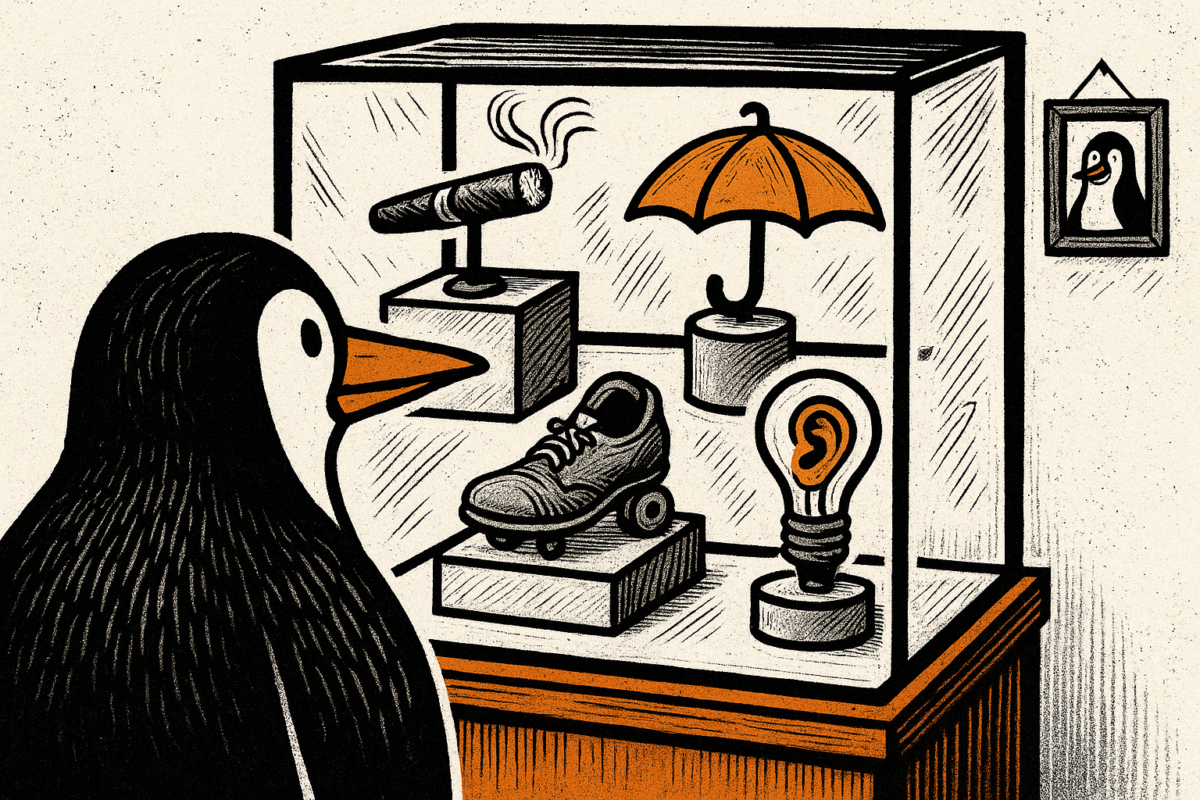
Every era thinks it is practical. Then history opens the junk drawer.
That drawer is full of inventions that sound like jokes, looked like nonsense, and occasionally changed the world anyway. Not because they were efficient, but because they were curious. Strange inventions are often little time capsules: they show what people feared, what they hoped for, and what problem they thought was urgent at 2:00 a.m. on a Tuesday.
This is not a parade of “look how silly people used to be.” It is a tiny history of what weird ideas can do when they survive long enough to become normal.
The Age of Mechanical Imagination
In the late 19th and early 20th centuries, inventors treated gears the way modern creators treat software. If something could be imagined, it might be mechanized.
Some devices were elegant and useful. Others were gloriously overbuilt. Pedal-powered contraptions promised healthier homes. Early automatic grooming tools promised to save time while introducing entirely new opportunities for scalp panic. There were attachments for everything: hats, shoes, bicycles, household furniture. If an object stayed still for too long, someone added a crank to it.
What looks ridiculous now often made perfect sense in context. A machine that automated one annoying chore could feel revolutionary in homes where labor was repetitive and physically intense. The design language was often dramatic because invention itself was theatrical. A patent drawing was not just technical documentation; it was a small act of optimism.
We tend to remember the successful machines as inevitable and the odd ones as mistakes. But at the time, they were siblings. Nobody had a clean map. They had prototypes, hope, and a lot of metal parts.
When Fear Invents
Some strange inventions come from delight. Many come from anxiety.
In periods of rapid change, people buy devices that promise control. Safety gadgets, anti-crime gadgets, anti-accident gadgets, anti-everything gadgets. Some worked. Some mostly calmed nerves. That distinction matters, but both categories are historical evidence of the same thing: uncertainty creates markets.
According to museum collections and patent archives, especially those that catalog household and civil-defense objects, entire product categories appear during moments of social stress and then fade when the stress changes shape. You can almost read public mood through the objects left behind. A bizarre protective visor might look comic now, but it can reveal a very specific fear that felt urgent at the time.
There is a useful lesson here for modern readers: odd inventions are not random. They are often emotional technology. They are tools people build to negotiate risk, status, and belonging.
The Demo That Failed Forward
Many strange inventions are not dead ends. They are awkward first chapters.
The first versions of major technologies are frequently clunky, expensive, and overpromised. They do too little, weigh too much, or solve a problem no one has in that exact way. Yet pieces of those failed inventions migrate. A sensor here, a material there, an interface pattern that later becomes familiar.
According to major science and technology history institutions, failed consumer products often contribute directly to later breakthroughs because teams learn what users reject, not just what they prefer. Failure, in this sense, is not a collapse but a sorting process.
That is why old “bad ideas” deserve a second look. The anti-solution can teach as much as the solution. The invention that made people laugh might still be the ancestor of something now embedded in your phone, car, or kitchen.
Why We Love the Weird Ones
There is also a cultural reason we keep retelling these stories: weird inventions are democratic. You do not need to understand advanced engineering to appreciate a machine that looks like a violin case married a lawn tool.
Strange objects invite conversation across expertise. Engineers ask, “What problem was this trying to solve?” Historians ask, “What does this reveal about its moment?” Everyone else asks, “Whose idea was this, and did anyone test it first?”
Humor helps here. Laughter can open the door to better questions. Once we stop using “ridiculous” as a full explanation, we notice constraints, materials, labor, marketing, and public imagination. The weird invention becomes less of a punchline and more of a social document.
And, honestly, part of the joy is personal. Strange inventions let us feel continuity with earlier generations. We are not uniquely confused. We are participating in a long tradition of trying odd things in public and hoping nobody notices the first draft.
A Small Rule for Modern Innovation
If there is one practical takeaway from this tiny history, it is this: evaluate weird ideas by trajectory, not first impression.
A strange invention can fail as a product and succeed as an experiment. It can miss its target market and still move design forward. It can solve the wrong problem today and the right problem five years later under different conditions.
This does not mean every eccentric prototype deserves applause. Many deserve retirement. But serious innovation cultures tend to preserve room for ideas that look mildly absurd before they look obvious.
That is the quiet discipline behind inventive progress: keep standards high, keep evidence central, and keep at least one shelf available for improbable things.
What to watch next
- How patent language changes during moments of public anxiety versus economic confidence.
- Which “failed” devices are being rediscovered through modern materials and better interfaces.
- How museums and archives are reframing odd inventions as social history, not novelty.
- Where playful prototyping in universities is producing serious tools a decade later.
Thanks for spending a Wednesday in the historical junk drawer. If you spot a bizarre old device this week, give it one extra look before laughing. It might be someone’s rough draft of the future.
Note: No retrievable links were available from the approved source allowlist for this draft, so this piece is presented without specific inline citations.