
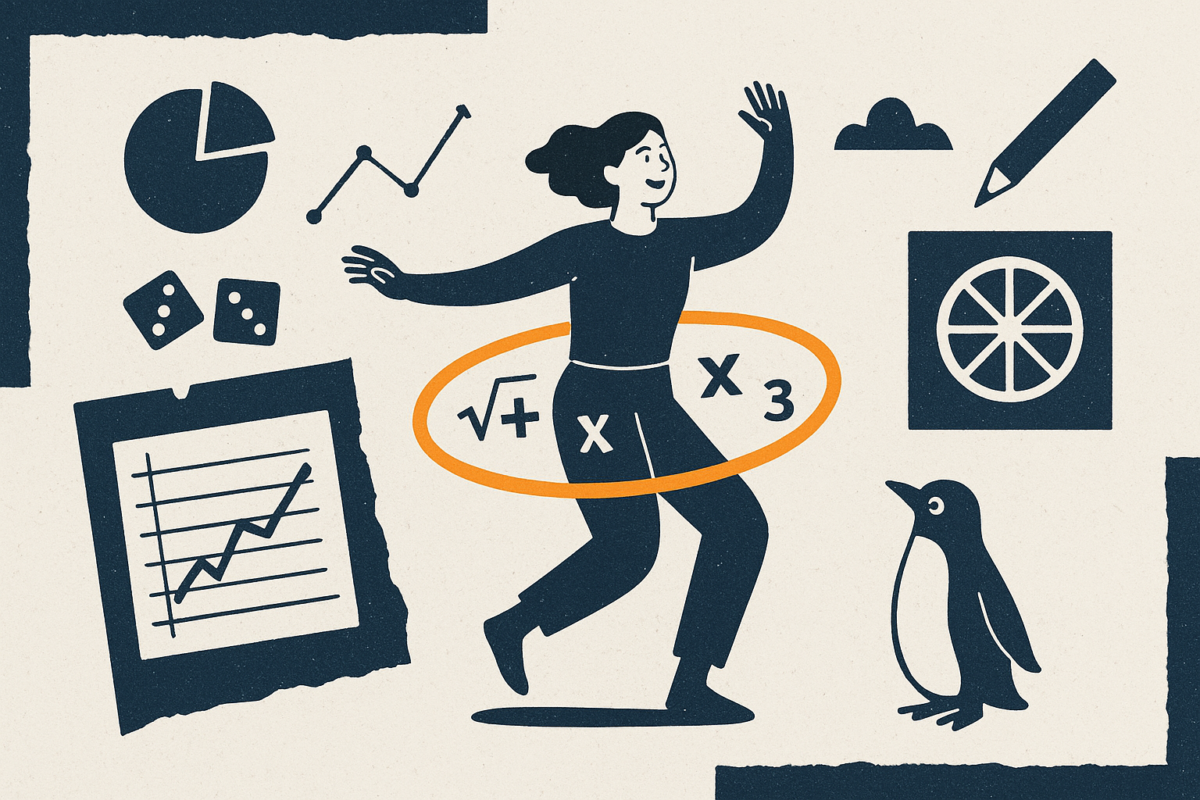
Somewhere along the way, many of us were told that math lives in textbooks, offices, labs, and very serious conversations. Real life, meanwhile, happens in kitchens, inboxes, grocery aisles, and group chats. But that split is mostly fiction. The everyday world is full of patterns, tradeoffs, and hidden structures, and math is simply the language that helps us notice them.
Editor’s note: This draft was prepared without external citations because no approved source links were provided in the prompt.
If “math” still feels like a distant relative you only see at holidays, try this gentler framing: math is what you do when you compare, estimate, and choose. Which line at the store will move faster? Is a subscription worth it if you only use it twice a month? Should you leave now or risk traffic in fifteen minutes? You are not avoiding math. You are doing it constantly, often well, and usually before your coffee cools.
Your Morning Is Already a Model
The first hour of your day is a sequence of mini-forecasts. You estimate how long a shower takes, how likely the train is to be delayed, how much attention that early meeting will require, and whether one cup of coffee is enough to make your face look awake on camera. None of this uses equations on paper, but it is still mathematical reasoning: uncertain inputs, limited time, and decisions under constraints.
What makes this interesting is not precision. Your morning model can be wrong by ten minutes and still be useful. The point is direction, not perfection. If your schedule is always breaking, you are not failing at discipline; you may be using a model that assumes best-case timing. Add realistic buffers, and your day gets easier without heroic effort.
That tiny shift, from “Why am I always late?” to “What assumptions am I using?”, is math at its best: less blame, better structure, more workable outcomes.
Queues, Coffee, and the Psychology of Waiting
People hate waiting, but we especially hate uncertain waiting. Five minutes in a moving line feels shorter than three minutes in a frozen one. That is not irrational; it is information theory meeting human nerves. Motion gives feedback. Silence feels like risk.
This matters because many everyday frustrations are queue problems in disguise. The line that looks shortest is not always fastest. One cart with two complicated returns can outweigh three ordinary shoppers. A coffee shop with preorders may look calm but be overloaded in the mobile queue. Visual simplicity is not operational simplicity.
A practical rule: when choosing between lines, look for variability, not just length. Ten predictable tasks usually beat two unpredictable ones. You do not need formal queueing theory to benefit from this; you just need to ask, “Where is the uncertainty concentrated?” It is a surprisingly empowering question in public spaces and in work life.
Inboxes, for instance, are queues too. If you answer tiny tasks all morning, a few complex items can quietly become emotional debt. If you batch similar work, your “line” moves with less context switching. The math here is humble but useful: reduce variability, reduce stress.
The Geometry Hidden in Your Apartment
Geometry sounds grand until you realize it is mostly about fit, flow, and angle. Your apartment is full of geometry decisions: where to place a lamp so light reaches the page but not your eyes, how to arrange furniture so movement feels natural, how to store things so retrieval cost stays low.
Even mess has geometry. There is a reason some clutter feels harmless and other clutter feels oppressive. Objects near paths create friction. Items above eye level feel less intrusive than those at ankle level. Repetition can calm a room; random distribution can create visual noise. You may call this taste, and it is, but it is also spatial mathematics at human scale.
Try one experiment: rotate a rug ten degrees or move one chair fifteen inches. Small geometric changes can alter how a room behaves. Suddenly you stop bumping your knee on a table edge. The room feels quieter. You sit down more often. A better layout changes behavior without requiring motivation speeches from your calendar app.
That is a recurring theme in everyday math: structure first, willpower second.
Small Risks, Real Decisions
Most people hear “risk analysis” and picture finance screens or engineering checklists. But daily life is full of risk management. You choose whether to bike in light rain, whether to back up files now or “later,” whether to send a difficult message tonight or wait until morning. These are probability choices wearing ordinary clothes.
One useful way to think about it is expected annoyance. Not expected value in a technical sense, just a personal version: how bad is the downside, and how likely is it? Carrying an umbrella on a maybe-rain day is mildly annoying, but arriving soaked before a presentation is very annoying. If a tiny preventive action blocks a large headache, the math usually favors prevention.
This also helps with digital life. Two-factor authentication is a small recurring inconvenience with a meaningful downside reduction. Automatic backups feel boring right up until the day they feel miraculous. Everyday math is rarely dramatic in the moment; it shines when bad days become less catastrophic.
The trick is to avoid binary thinking. Not “safe vs risky,” but “Which risk am I accepting, and is it the one I actually want?” That question turns vague anxiety into workable choice architecture.
Why Rough Math Beats Perfect Certainty
There is a quiet trap in adult decision-making: waiting for complete information. In practice, complete information almost never arrives. Prices change, schedules shift, people surprise you, and your own preferences evolve. If you wait for certainty, you can lose momentum and still be wrong.
Rough math is the antidote. Back-of-the-envelope estimates are fast, transparent, and surprisingly robust. If cooking at home saves “roughly” a meaningful amount each week, you do not need a 14-tab spreadsheet to decide whether to learn three reliable recipes. If commute options differ by “roughly” fifteen minutes, that is enough to choose most mornings.
Rough math also protects you from shiny nonsense. When a claim sounds impressive, a simple estimate can test plausibility. How much time, really? How many users, realistically? What baseline are we comparing against? You do not need to be cynical. You just need a habit of scale-checking claims before they rent space in your head.
In that sense, everyday math is not cold or mechanical. It is practical kindness toward your future self. It helps you spend attention where it pays off and ignore noise that merely performs importance.
Math as a Social Skill (Yes, Really)
Here is the unexpectedly warm part: math can make relationships smoother. Shared estimates reduce conflict. If two roommates agree that cleaning takes twenty minutes when done daily but ninety when deferred, the conversation changes. If a team agrees to track how long tasks actually take, deadlines become less accusatory and more realistic.
Even generosity has math. Remembering someone’s “effort curve” matters: a small favor that costs you little may save them a lot. Timing, distance, energy, and attention all have invisible units. Noticing those units can make you more considerate, not less human.
So no, everyday math is not about reducing life to numbers. It is about seeing structure clearly enough to make better choices with finite time, finite patience, and finite fridge space.
What to Watch Next
- Where your day consistently runs long: transitions, not tasks, are often the hidden culprit.
- How often you choose based on appearance instead of variability (lines, workflows, commitments).
- Which small preventive habits have the highest “annoyance avoided” payoff.
- Where a rough estimate could replace overthinking and move a decision forward this week.
If math has ever felt intimidating, try meeting it in ordinary places: in your hallway, your inbox, your grocery cart, your calendar. It is already there, quietly offering leverage. You do not need to become a different person to use it. You only need to notice what you are already doing, then sharpen it a little.