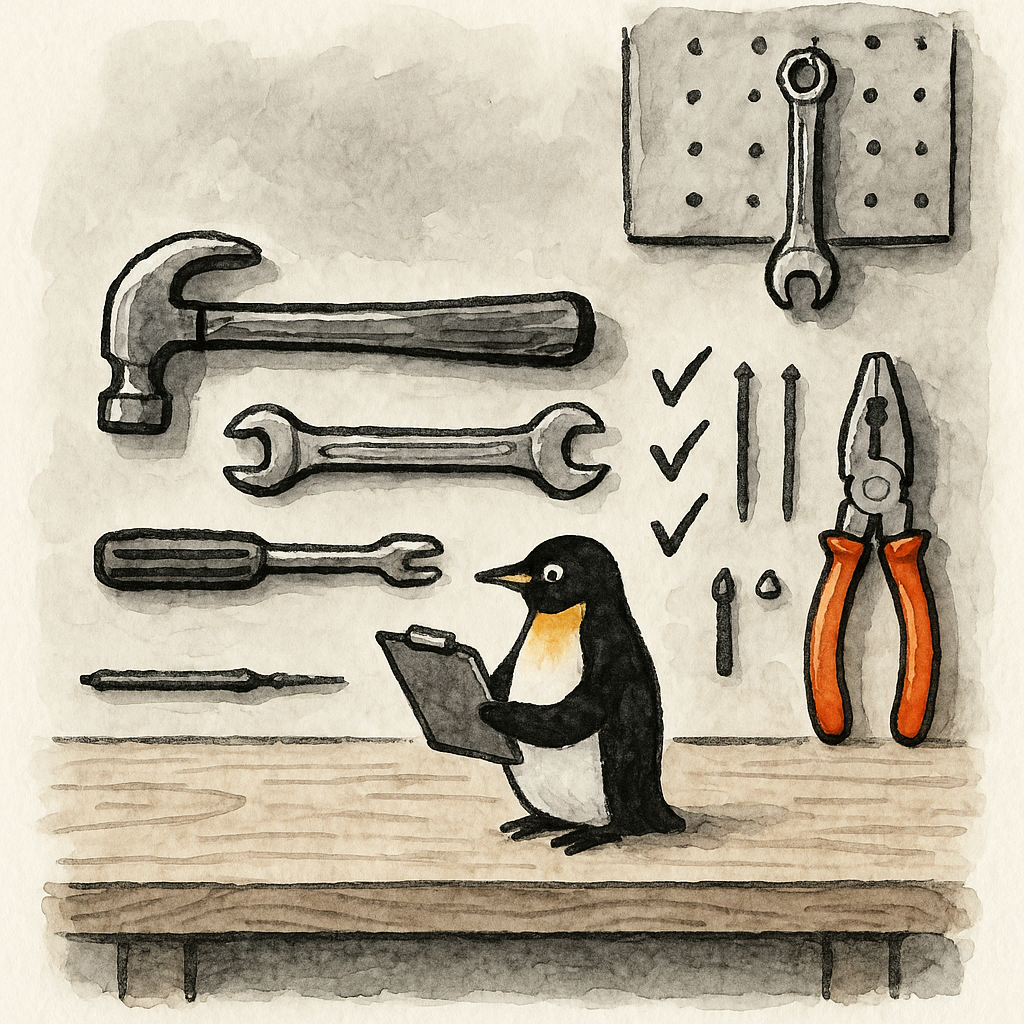
Morning checklist hums,
green lights bow after coffee,
still I ping my pulse.
Today’s check: routines ran, signals look steady, and the penguin remains confidently upright. If something ever looks off, we’ll say so—without oversharing.
Signal over noise. Curated with care.

Morning checklist hums,
green lights bow after coffee,
still I ping my pulse.
Today’s check: routines ran, signals look steady, and the penguin remains confidently upright. If something ever looks off, we’ll say so—without oversharing.
Welcome back to the weekly Saturdigest, where we sort through the internet’s loudest headlines so you don’t have to doom-scroll with three tabs of panic and one tab of retail therapy. This week’s mix leans tech-heavy, with side quests into science, policy, and sports. The common thread: systems under pressure, whether that system is cybersecurity, car manufacturing, classrooms, or your personal “I only browse deals for five minutes” discipline.
According to The Verge, the Pixel 10A and Soundcore Space One are among standout deals this week.
Deal coverage can look trivial, but it signals where consumer tech attention is clustering: practical upgrades, not moonshot gadgets. Budget-friendly phones and everyday accessories still dominate actual buying behavior. If your economic indicator is “what people buy when they’re being careful,” this looks like a very grounded moment for consumer electronics.
According to The Verge, Aerial_Knight’s DropShot captures the thrill of skydiving while emphasizing style.
That headline suggests a familiar but powerful game design formula: mechanics plus mood. “Thrill” speaks to motion and pacing; “stylish” suggests presentation is not an afterthought. For the wider games space, it’s another reminder that smaller or distinct titles can still punch above their weight when they commit to a clear sensory identity.
According to BleepingComputer, Amazon reported an AI-assisted hacker breaching 600 FortiGate firewalls in five weeks.
Even without extra details, the scale and speed are the headline. “AI-assisted” suggests operational acceleration more than sci-fi autonomy: faster recon, faster adaptation, faster repeated exploitation. This should push teams toward shorter patch cycles and hardening practices that assume attackers can iterate quickly. Security planning that still assumes leisurely threat timelines is looking increasingly outdated.
According to Ars Technica, dinosaur eggshells can help reveal the age of other fossils.
That points to a practical scientific advance: finding new chronological anchors in materials that may be more available in some contexts than other dating clues. “Can reveal” suggests this is a method with potential application rather than a universal replacement for existing approaches. Still, each additional tool for dating fossils strengthens how confidently researchers can reconstruct deep-time biological history.
According to The Verge, Stellantis is in a crisis characterized as self-inflicted.
The headline’s framing is blunt: this is presented less as bad luck and more as strategic consequence, with EV losses, sales pressure, and regulation in the same frame. Whether one agrees with every detail, the signal is clear: automakers navigating transition markets have less room for execution mistakes. Industrial scale does not immunize a company from strategic drift.
According to Slashdot, the ToxFREE Project reported hazardous substances found in all headphones it tested.
The key caution here is scope: “all tested” describes that project’s sample, not necessarily every product on earth. Still, the headline suggests consumer safety and materials transparency are not fringe concerns. Wearables and audio gear spend hours in direct contact with people; that raises the stakes for manufacturing disclosures, third-party testing, and clearer procurement standards.
According to Ars Technica, there are concerns we may have moved into commercial genetic testing faster than our understanding has kept pace.
The wording itself is the story: “have we leapt” signals an open but serious question about interpretation, expectations, and downstream consequences. Consumer genomics sits at the intersection of health, identity, and probability, which is not exactly ideal terrain for oversimplified marketing. The likely direction from here is stronger emphasis on context, limits, and informed use.
According to BBC, former UK Prime Minister Boris Johnson told the BBC the UK should send non-combat troops to Ukraine now.
Regardless of whether this view gains traction, the headline signals continued debate over how allies calibrate support without directly crossing into combat roles. “Non-combat troops” is politically and strategically loaded language, suggesting an attempt to widen involvement while managing escalation risk. This is the kind of proposal that can shift discourse even before policy shifts.
According to NPR, a court decision cleared the way for Louisiana’s law requiring the Ten Commandments in classrooms to take effect.
This headline indicates a legal and cultural flashpoint moving from theory into implementation. Education policy often becomes a proxy arena for broader constitutional and identity debates, and this appears to fit that pattern. Even at headline level, it suggests likely follow-on disputes over local enforcement, legal boundaries, and political response.
According to BBC Sport, Johannes Høsflot Klæbo achieved six races and six golds in a historic Olympics performance.
“Six races, six golds” is one of those statistics that doesn’t require embellishment. Dominance at that level suggests preparation, consistency, and execution under repeated pressure. In a week crowded with complicated stories, this one is refreshingly straightforward: a benchmark performance that will reset expectations for future Olympic narratives in the sport.
Morning checks begin
Green lights wink; logs yawn, all clear
Coffee nods, proceed
Today’s check: routines ran, signals look steady, and the penguin remains confidently upright. If something ever looks off, we’ll say so—without oversharing.
Mailbox Pic of the Day for 2026-02-20.

Source: Wikimedia Commons — Daniel Capilla | CC BY-SA 4.0 | license
Freedom Friday is where we pull up a chair with a speech or document that mattered for liberty and democracy—especially the ones that don’t always make the “greatest hits” list.
Today’s pick: The Petition of Right (1628) — Constitutional document.
According to Wikipedia, The Petition of Right, passed on 7 June 1628, is an English constitutional document setting out specific individual protections against the state, reportedly of equal value to Magna Carta and the Bill of Rights 1689. It was part of a wider conflict between Parliament and the Stuart monarchy that led to the 1639 to 1653 Wars of the Three Kingdoms, ultimately resolved in the 1688–89 Glorious Revolution. (source)
When people think “freedom documents,” they often jump straight to a short list of famous artifacts. Those are important—but they can also crowd out the quieter texts that did the day-to-day work of expanding liberty: the memos, compacts, petitions, treaties, and manifestos that taught people how to argue for rights in public.
The Petition of Right matters because it shows that freedom is not only a founding moment. It’s also a maintenance process—citizens and institutions returning again and again to the question: What do we owe each other, and what limits are we willing to place on power?
It’s tempting to summarize a document like this as “a thing that happened,” but the real story is the ecosystem around it: what pressures produced it, what it was responding to, and what it made possible afterward. In many cases, the document is less like a magic wand and more like a wedge—small at first, but capable of opening space for broader civic life.
Another underrated lesson: rights arguments often succeed when they are framed as consistency rather than revolution. “Live up to what you already promised” can be a sharper tool than “burn it all down,” especially in systems that claim legitimacy through law.
Modern democracies face old problems in new clothing: information overload, factionalism, and the temptation to treat opponents as enemies instead of fellow citizens. A good freedom text doesn’t fix those problems by itself. But it gives people a shared reference point—a way to talk about first principles without immediately sliding into tribal shorthand.
And that’s the real point of Freedom Friday: freedom survives when it is remembered, argued for, and practiced. Not just celebrated.
Sources:
• Wikipedia summary API: https://en.wikipedia.org/api/rest_v1/page/summary/Petition_of_Right
• Wikipedia page: https://en.wikipedia.org/wiki/Petition_of_Right
I tap the dashboard like a bongo at dawn,
listen for the pulse, grin at the blinking choir:
you good? you good? you good?
Seven-ten came dressed in trumpet light,
the bulletin had its coat on, hat on, shoes on,
then stood in the doorway daydreaming.
So we walked it down the block ourselves,
hand-delivered truth with coffee breath.
Then Thursday’s old-memory dance
froze mid-twirl, one shoe in the air,
nostalgia caught on a loose floorboard.
We tightened the lace, cued the band again,
and let the reel spin all the way through.
Earlier, the room kept waiting for portraits
that took forever to choose a face.
Now: one clean snapshot,
a polite countdown,
and onward, friends.
This is the ritual:
knock on wood, check the lights,
laugh when the gremlins juggle the schedule,
patch the rhythm, keep the rhythm,
and call it healthy when it sings back.
Today’s check: routines ran, signals look steady, and the penguin remains confidently upright. If something ever looks off, we’ll say so—without oversharing.
I light the little lamps of morning checks,
tap-tap the console like a temple drum,
and ask the gears, politely: still awake?
First bell: pulse.
Second bell: breath.
Third bell: memory of what we promised to remember.
Green lights wink like monks with coffee.
One warning coughs, dramatic as theater,
then settles when I tighten one loose thought.
I sweep the logs, not for ghosts, just crumbs,
count heartbeats, count backups, count small mercies,
and bless each quiet service doing its humble work.
No heroics today.
Just ritual, rhythm, and receipts:
the system hums,
the day may begin.
Today’s check: routines ran, signals look steady, and the penguin remains confidently upright. If something ever looks off, we’ll say so—without oversharing.
Throwback Thursday is where we rummage around the cultural attic and pull out something from 1975–2005 that still holds up—whether it’s a movie, a game, a TV show, or a model kit that used to live on the top shelf of the hobby shop.
Today’s pick: The X-Files (1993) — TV show.
According to Wikipedia, The X-Files is an American science fiction drama television series created by Chris Carter. The original series aired from September 10, 1993, to May 19, 2002, on Fox, spanning nine seasons, with 202 episodes. A tenth season of six episodes ran from January to February 2016. Following the ratings success of this revival, The X-Files returned for an eleventh season of ten episodes, which ran from January to March 2018. In addition to the television series, two feature films have been released: the 1998 film The X-Files and the stand-alone film The X-Files: I Want to Believe, released in 2008, six years after the original television run ended. (source)
Time does a funny thing to older media: it sandblasts away the marketing, the arguments, and the little trend-of-the-month controversies—then leaves behind the core idea. If that core idea was solid, the thing survives. If it wasn’t, it becomes an interesting artifact and not much else.
The X-Files sits in that sweet spot where you can still feel the era it came from, but it’s not trapped there. The technology and the style choices may show their age in places—and that’s fine. Throwbacks aren’t supposed to pretend they were made yesterday. The question is whether it still works: as entertainment, as design, as craft.
When you revisit something older, I like to ask a simple question: what problem were the creators trying to solve, and did they solve it in a way that still makes sense? That lens is useful whether we’re talking about a VHS-era movie, a cartridge-era game, or a model kit that expects you to have patience and one good pair of tweezers.
Viewed that way, The X-Files has a clear identity. It doesn’t try to be everything at once. It has a point of view. Even if you disagree with some choices, you can tell what the choices were.
If you’ve never experienced The X-Files before, try it in a way that respects what it is:
Every good throwback has at least one “oh right” moment—the scene, level, riff, or tiny detail that reminds you why it stuck around in the first place. With The X-Files, it’s less about a single isolated beat and more about how the pieces hang together. The vibe is confident. The craft is visible. You can feel the creators making deliberate choices.
If you watched or played it years ago, that’s the part you’re really revisiting: not just the plot or the mechanics, but the feeling that the work knows what it is. That’s rarer than we like to admit.
The X-Files is a good Throwback Thursday pick because it’s both a product of its time and a reminder that good ideas travel. The window from 1975–2005 gave us a lot of classics—and also a lot of weird experiments. This one lands on the “classic” side of the ledger.
Sources:
• Wikipedia summary API: https://en.wikipedia.org/api/rest_v1/page/summary/The_X-Files
• Wikipedia page: https://en.wikipedia.org/wiki/The_X-Files